What is a risk assessment?
It is nothing more than a careful examination of what, in your work, could cause harm or affect the health of people – your employees, other workers, public.
Have you taken enough precautions, or should you do more to prevent harm?
Accidents or ill health can ruin lives and can affect your business.
You are legally required to assess the risks in the workplace.
Is a hazard’s significant and have you taken steps to MINIMISE or ideally ELIMINATE the risk?
How do you assess the risks in your workplace?
| 1. | Look for the hazards. |
| 2. | Decide who may get harmed and how. |
| 3. | Evaluate the risks – are existing precautions adequate? |
| 4. | Record your findings. |
| 5. | Review your assessment and revise if necessary. |
Don’t be over-complicated.
If the hazards is complex, seek help from an a competent source or collaborate with others.
Hazard: means anything that can cause harm.
Risk: is the chance, high or low, that somebody will be harmed by the hazard.
Look for hazards
If you are doing the assessment yourself, walk around your workplace and look afresh at what could reasonably be expected to cause harm. Ignore the trivial and concentrate on significant hazards which could result in harm or affect a person or multiple people.
Ask your employees what they think. They may have noticed things which are not immediately obvious to you. Remember, they are working in the environment, not you.
Consultation with employees also gives them a sense of ownership and involvement in the safety process.
Manufacturers instructions or safety data sheets (MSDS) can also help you spot hazards and put their risks in true perspective. View past accident records, and ill health records.
Decide who might be harmed, and how.
Don’t forget:
| • | Young workers, trainees, new and expectant mothers, etc. who may be at particular risk. |
| • | Cleaners, visitors, contractors, maintenance workers, etc. who may not be in the workplace all the time. |
| • | Members of the public, or people you share your workplace with, if there is a chance they could be hurt by your activities. |
Evaluate the risks and decide whether existing precautions are adequate or more should be done.
Consider how likely it is that each hazard could cause harm.
This will determine whether or not you need to do more to reduce the risk.
Even after all precautions have been taken, some risks usually remain.
What you have to decide for each significant hazard is whether this remaining risk is considered HIGH, MEDIUM or LOW.
First, ask yourself whether you have done all the things the law says you have to do. For example, there are legal requirements on prevention of access to dangerous parts of machinery. Then, ask yourself whether generally accepted are in place, and whether they are adequate.
The law requires you to take ‘reasonably practicable’ steps to keep you workplace safe.
Consider the law to be a ‘minimum requirement’ – strive to be better than that.
Make all risks small by adding to your precautions as is necessary.
If you find something needs to be done, draw up an ‘action list’ and give priority to any remaining risks which are high and /or those which could affect most people.
In taking action, ask yourself:
| 1. | Can I eliminate the hazard? |
| 2. | If I cant eliminate, what can I do to reduce the risks so that harm is unlikely. |
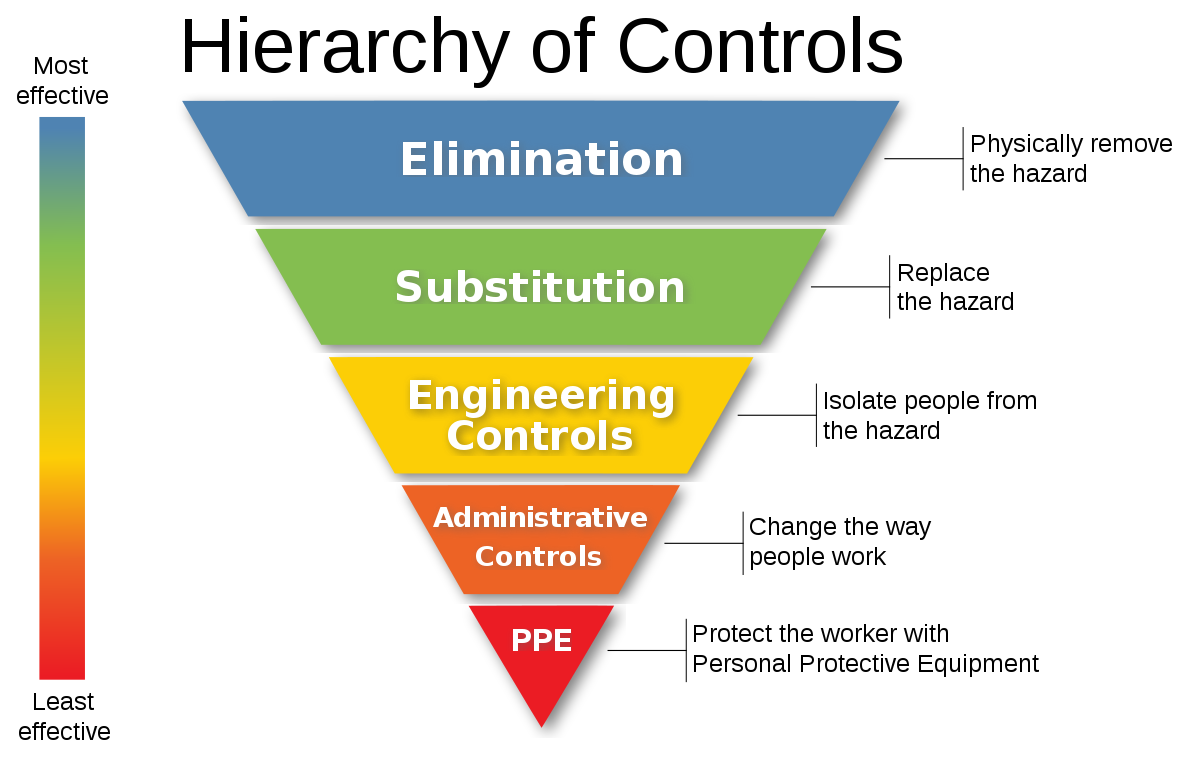
In controlling risks apply the principles below, if possible, in the following order:
Try an option with less risk.
Prevent access to the hazard (e.g. by guarding – ‘engineering controls’)
Organise work to reduce exposure to the hazard.
Issue PPE.
There is a commonly used diagram to explain this:
Reducing risk need not be expensive nor time consuming.
Do the easy and cost effective steps as quickly as possible.
Failure to take simple precautions can cost you way more if an accident occurs.
What if you share a workplace?
Tell the other employers and contractors about any risks your work could cause them, and what precautions you are taking. Also, think about the risks to your own workforce from those who share your workplace.
Risk assessments must be suitable and adequate.
You need to show that:
| • | A proper check was made. |
| • | You asked who may be affected. |
| • | You dealt with the obvious significant hazards, taking into account the number of people who could be involved. |
| • | The precautions are reasonable, and the remaining risk is low. |
Hazard review
Work process can change – new site, new people, new materials, new machines, new design, etc. Although you had created a hazard assessment, review your initial hazards assessment and see what new hazards have been introduced. Revise the risk assessment (ideally with input from workers on site), and then communicate the updated information to the persons who may be affected.
Ensure the precautions take remain effective.
Record your findings
Update your own documentation on a regular basis, and communicate with your own employees often. By recording information, it can help you if there is an unwanted event, and you are required to account for your actions to inspectors or tribunals. It can also remind you to keep an eye on a particular hazard and its precautions.
Communicate – in writing – with other companies if you identify site hazards which may affect your workers or others.
To make things simpler, you can refer to other documents such as manuals, policy, company rules, emergency procedures, safe work procedures (SWP), safe operating procedures (SOP), regular Toolbox Talk training sheets, which should be discussed with all affected employees. And, get all participants to sign acknowledgement of the training session and specifically that they UNDERSTOOD the contents of the training session.